
Day 1Upper — strength
- Bench press4 × 5–6
- Barbell row4 × 6–8
- Overhead press3 × 6–8
- Pull-up3 × max
Oct 1 to Dec 31 · 92 days
The Winter Arc is the last three months of the year spent locked in: training, eating and sleeping on purpose while everyone else waits for January. Here is how to run it, a 13-week gym plan to follow, and how to keep score one week at a time.

 Coming soon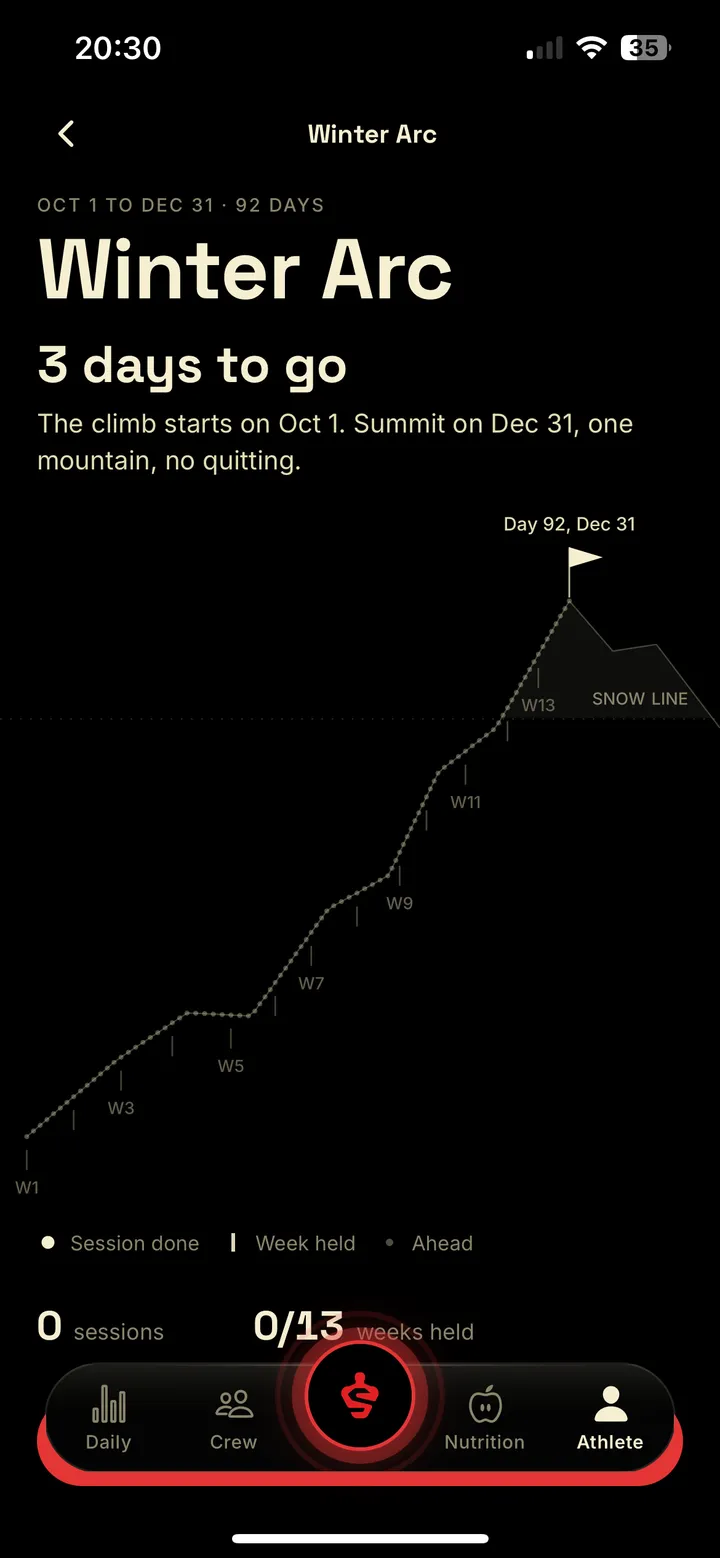
| Dates | October 1 to December 31, 2026 |
|---|---|
| Length | 92 days, 13 weeks |
| What counts | Weeks held, not perfect days |
| Default target | 3 training days a week |
| Finish line | December 31, the summit |
“Winter Arc” started as a social media trend: treat the final stretch of the year as a season of quiet, focused self-improvement instead of waiting for a New Year's resolution. Fewer distractions, more discipline, and a visible change by the time January arrives.
For most people who lift, it means a fixed start (October 1), a fixed end (December 31) and a simple promise in between: train consistently, eat enough protein, sleep, and do not quit halfway. The appeal is the deadline — 92 days is long enough to see real progress and short enough to stay committed.
Pick a weekly target you can keep — three training days is a solid default — and count the weeks you hold. A rest day is part of the plan, not a failure.
Add a rep, a set or a small amount of weight when you hit the top of your rep range. Three months of small increases is where the visible change comes from.
Around 1.6 g of protein per kg of bodyweight per day is a common evidence-based target for building muscle. Hit it on training and rest days alike.
Seven to nine hours. A short night is a reason to train a little lighter, not to skip — and not a reason to abandon the arc.
Track every session and every week held. Seeing the climb is what keeps you going in week 7, when the novelty has worn off.
Three blocks, one deload, and a final push to the summit. Use the sample week below and progress it through each block.
Learn the lifts, find your working weights and build the habit. Stop every set with two or three reps in reserve.
Progressive overload every week: when you hit the top of the rep range on all sets, add weight next session.
Keep training, but cut the number of sets by about 40% and keep the weight. You recover, the habit stays intact.
Your heaviest weeks. Push the main lifts, then finish December by beating a number from week 1.
Four gym days, upper/lower split. Holding three of them still holds the week.
Not sure about your form on a lift? Each exercise links to a free guide on the most common mistakes and how to fix them.
Stance has a Winter Arc built in. Pick your day 1, and your season is drawn as a mountain: one point per day, one milestone per week, the summit on December 31.
Every session you log moves you up the climb. A week is held when you reach your own weekly target, and the number that measures your arc is the count of weeks held.
Coming soonThe Winter Arc traditionally runs from October 1 to December 31 — 92 days, or about 13 weeks. In Stance you can pick your own day 1, and the summit is always December 31.
Close: October 1 to December 31 is 92 days. People often call it a 90-day challenge because it is roughly three months.
Yes. Starting late is better than waiting for January. In Stance you choose your day 1 and the arc runs to December 31, with at least four weeks to climb.
Three to four sessions a week is enough for most people to make visible progress. Consistency across 13 weeks matters more than any single week.
Keep climbing. The arc is measured in weeks held, so one short week does not erase the others — the next week is a new milestone.
Stance is free to download on the App Store and the Winter Arc is part of the app. The Active and Elite subscriptions unlock the full AI coach.
This page is general training information, not medical advice. Adjust training and nutrition to your health, and consult a qualified professional if in doubt.